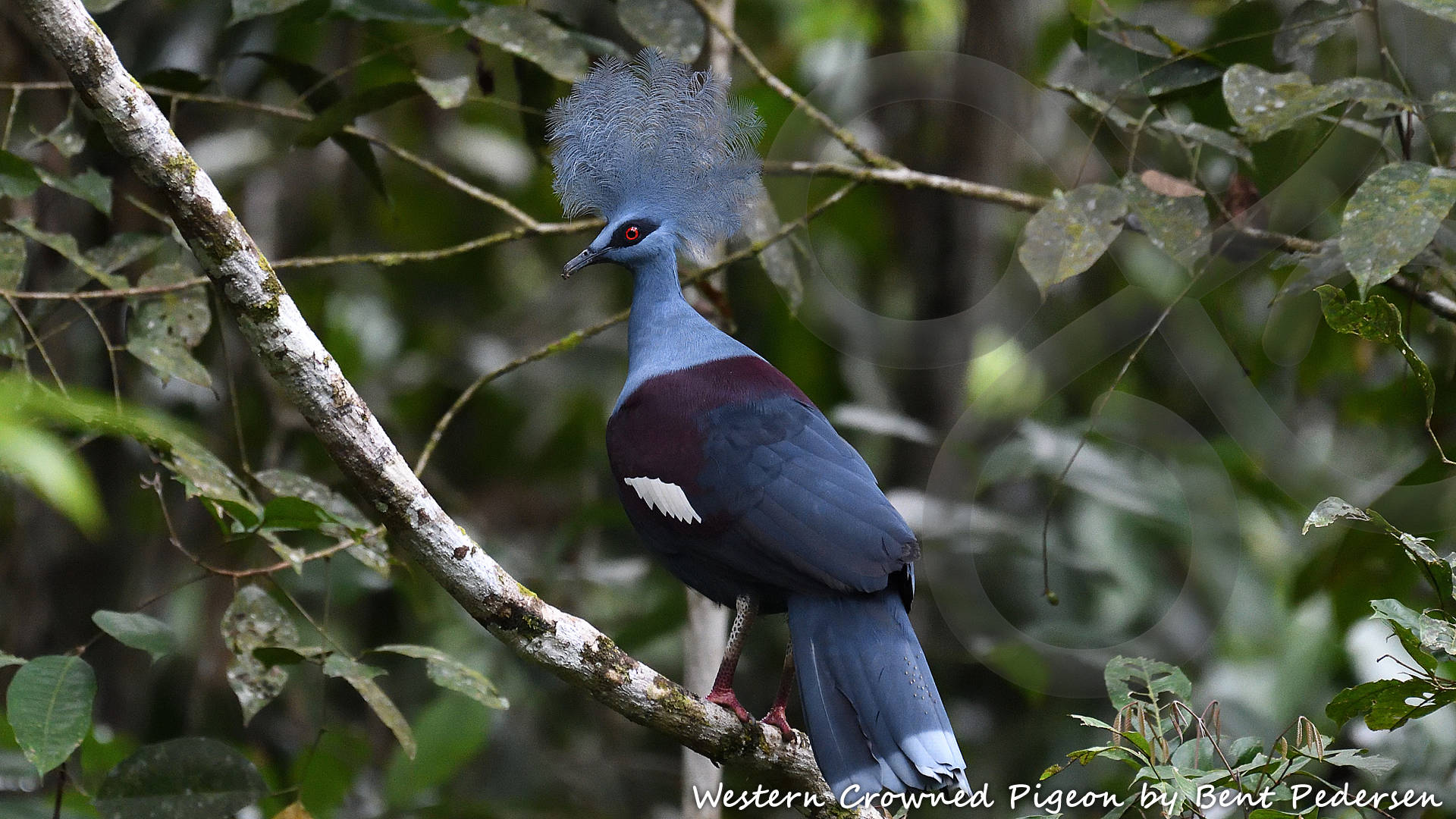
The majestic Western Crowned Pigeon Goura cristata is among 66 bird species that are endemic
to West Papua and, except for an introduced population on the Moluccan island of Seram, occurs nowhere else on Earth. Copyright
© Bent Pedersen
That ecotourism is inextricably linked to biodiversity and the struggle to secure its long-term survival follows
straightforwardly out of the sheer enjoyment that discerning ecotourists draw from visiting untouched natural environments and
getting up-close and personal there with charismatic flag-ship species, all in the knowledge of course that their visit actively
helps safeguarding all upon which their eyes feast.
At EKONEXION we strongly believe that the key to the long-term spiritual, social and economical well-being
of indigenous peoples lies precisely in the active preservation of their ancestral lands that set the stage for our ecotourism
activities. Ultimately, the long-term viability of our tourism products depends on this, and hence we always strive to make the
magnitude of our financial contributions and support to indigenous communities dependent on local conservation attitudes and the
degree of protection afforded to local wildlife and their habitats through wise land tenure.
EKONEXION in 10 quotes
Traditional societies in West Papua are rapidly being overtaken by the 21st century. Ever increasing
cash-dependency and the decay of customary land tenure systems incite indigenous communities to no longer principally oppose
resource extraction, but to merely expect to reciprocally benefit from it. Any conservation project intervention thus requires
effective cash-generating alternatives to rival destructive resource use, even if communities do understand the long-term
deleterious impact of such practices. Genuine ecotourism, in no small part, can make a difference here.
— Like Wijaya, Founder, EKONEXION, Indonesia
Our team would like to congratulate you on your outstanding commitment and responsible travel
efforts. We commend you on your dedication to environmental sustainability, and all of the outstanding social and environmental
programs and initiatives. We truly appreciate your hard work! — Wild Asia,
Malaysia
I want to say again thank you very much for organizing such a wonderful expedition. Working on the
'Life' project I have been fortunate enough to have filmed many great bird spectacles over the last two years, but our trip to
West Papua has been one of my favorites. This is not only because of the truly incredible birds, but also for the excellent
logistics which you set up. I don't think I have ever eaten so well while filming in a tropical forest!
— Barrie Britton, Cameraman 'Life', BBC Natural History Unit, UK
Your hard work in West Papua is well known and appreciated. The Chinese says the right road is tough.
— Felix Ng, Hong Kong SAR
The way EKONEXION implements ecotourism is impressive and should be widely copied. It actually took
me some time to fully understand the range of the work you are doing. State of the art 'ecotourism' currently seems to be
speeding along logging roads, but EKONEXION proves that you can even tick off a species list (if that's what you want) in a very
different way. — Carl Christian Tofte, Wildlife Artist, Denmark
A resounding thank you for introducing us to so many wonderful birds. Not cheap — everything is
expensive here at the end of the world — but worth every cent. — Victor Mason,
Founder, Bali Bird Walks, Indonesia
Congratulations to all our worthy winners and finalists. All of them are role models for the
industry. Their investment in community engagement, workers' welfare, cultural conservation and environmental stewardship
— make the travel industry a more exciting place to work. Most importantly, they're supporting long lasting development in
their destinations across Asia, ensuring a more sustainable future for the places we love to visit.
— Amy McLoughlin, Responsible Tourism Awards Coordinator, Wild Asia, Malaysia
Thank you all for such a wonderful trip. I can easily say that it surpassed all of my expectations.
The relaxed, easy-going nature of the whole expedition was only possible because of a great deal of time and effort going on
behind the scenes. It really was lovely to be in such a wonderful place with people who clearly love the area and take such care
and attention to show its secrets to others. And I could not write without reiterating my amazement at Like and her sous-chef's
abilities in creating such incredible food in such relatively bare surroundings. — Dr.
Catriona Wootton, UK
Needless to say we are still talking about our trip and the wonderful time we had, not the least of
which was the pleasure of your company. There is nothing we can think of that would enhance your tours. You have literally
thought of everything and really go the extra mile to ensure your guests are comfortable and get maximum value. We were also
most impressed with the way you deal with the local communities. — Doug and Ulai Kirwin,
Thailand
Thank you for your hospitality and kindness on my recent trip. You provided all I could have hoped
for and more. I would recommend EKONEXION as the first choice to anyone wanting to learn about the ecology of West Papua
firsthand. — Carel P. Brest van Kempen, Wildlife Artist, USA
❮ ❯
Over the past nineteen years, we have been experimenting with various types of ecotourism agreements in order to
formally regulate mutual commitments, rights, responsibilities, and obligations between us and the indigenous communities with
whom we work.
At one end of the spectrum, we pay a daily 'respectful usage' fee per visiting tourist to customary landowners or
land-holding groups as a mere token of our gratitude to trespass tribal land without restricting traditional usage or imposing
management actions.
On the opposite end of the spectrum, we engage into direct structured payments (annual or bi-annual) to customary
landowners or land-holding groups in return for carefully defined and monitored conservation outcomes, whereby any restrictions on
traditional usage are appropriately compensated. These latter types of agreements are inspired on the concept of Payment for
Ecological Services (PES), whereby a voluntary, contingent transaction is made between buyers and providers of a well-defined
environmental service or a land-use likely to produce that service.
In between the opposite ends of the spectrum then, there can be complex variations in agreements, but most
importantly, all our activities on ancestral lands controlled by indigenous communities are formally being regulated through a
Memory of Understanding or more legally binding agreement. Such agreements imply a varying degree of coordinated micro-management
based on the outcome of a prolonged deliberation process with customary landowners, village elders and authorities, as well as
broad segments of the community. These agreements are further subject to annual or bi-annual review and are thus being perfected
over the course of years, providing the best possible basis for continuous visitation.
Thus, by linking up the financial benefits of ecotourism with the continuous presence and protection of local
wildlife through wise land tenure, we instigate and nurture pride in customary landownership and bring a strong conservation
message.
❯Browse the Papua
Expeditions web site.
❯Read on about the natural
wonders of New Guinea (from PapuaExpeditions.com).
❯Read on about the geopolitical
and biogeographical delimitation of West Papua (from PapuaExpeditions.com).
❯Read on about the indigenous
peoples of West Papua (from PapuaExpeditions.com).
❯Read on about the flora
and fauna of West Papua (from PapuaExpeditions.com).
❯Read on about the birdlife
of West Papua (from PapuaExpeditions.com).